
Introduction
There is a reason farmhouse dining rooms never go out of style. They carry something that purely modern spaces often miss — a sense of warmth, history, and genuine welcome. You walk into a well-styled farmhouse dining room and immediately feel like someone is about to set a beautiful meal on the table, light a few candles, and pull up a chair for you.
Farmhouse dining rooms are built around a simple but powerful design philosophy: make the space feel lived-in, layered, and deeply comfortable. That means mixing old and new, rough and smooth, practical and beautiful. It means a reclaimed wood table worn at the edges, linen chairs that invite lingering, a chandelier that throws warm golden light across the whole scene, and a centerpiece that looks gathered rather than purchased.
What makes this style so popular right now is how accessible it is. You do not need a century-old farmhouse or an unlimited budget. These ideas work in new construction homes, suburban dining rooms, small apartment eating areas, and everything in between. The principles are simple. The results are stunning.
I have styled and lived in farmhouse-inspired dining rooms for years, and what I keep coming back to is how genuinely comfortable these spaces feel — not just to look at, but to actually sit and spend time in. That is the goal. Here are thirteen ideas to get you there.
Key Takeaways
- Farmhouse dining style is built on warmth, texture, and a mix of old and new materials
- A reclaimed or solid wood dining table is the single most impactful foundational piece
- Layering lighting — a chandelier plus candles — creates the signature farmhouse ambiance
- Neutral base colors with warm undertones work better than cool grays in this style
- Vintage and collected accessories always look more authentic than perfectly matched sets
- Upholstered bench seating mixed with chairs creates effortless, inviting informality
- Most farmhouse dining looks are beginner-friendly and achievable on a range of budgets
Why Farmhouse Style Works So Well in Dining Rooms
The dining room is one of the most emotionally loaded rooms in a home. It is where families gather, celebrations happen, and memories are made around a shared table. Farmhouse design philosophy aligns perfectly with that purpose.
The style celebrates natural materials — wood, linen, cotton, iron, stone — that feel genuine and grounded. It embraces imperfection: a slightly worn table, a mismatched chair, a handmade ceramic bowl. It layers texture upon texture until the room feels rich and welcoming without feeling formal or intimidating.
And crucially, farmhouse dining rooms are functional first. The furniture is sturdy. The fabrics are washable. The accessories can be moved, rearranged, and refreshed seasonally. This is a design style built for real life — for families, for gatherings, for Sunday mornings with coffee and a newspaper spread across the table.
That combination of beauty, warmth, and practicality is why this aesthetic continues to resonate so deeply across the country.
1. Reclaimed Wood Statement Table
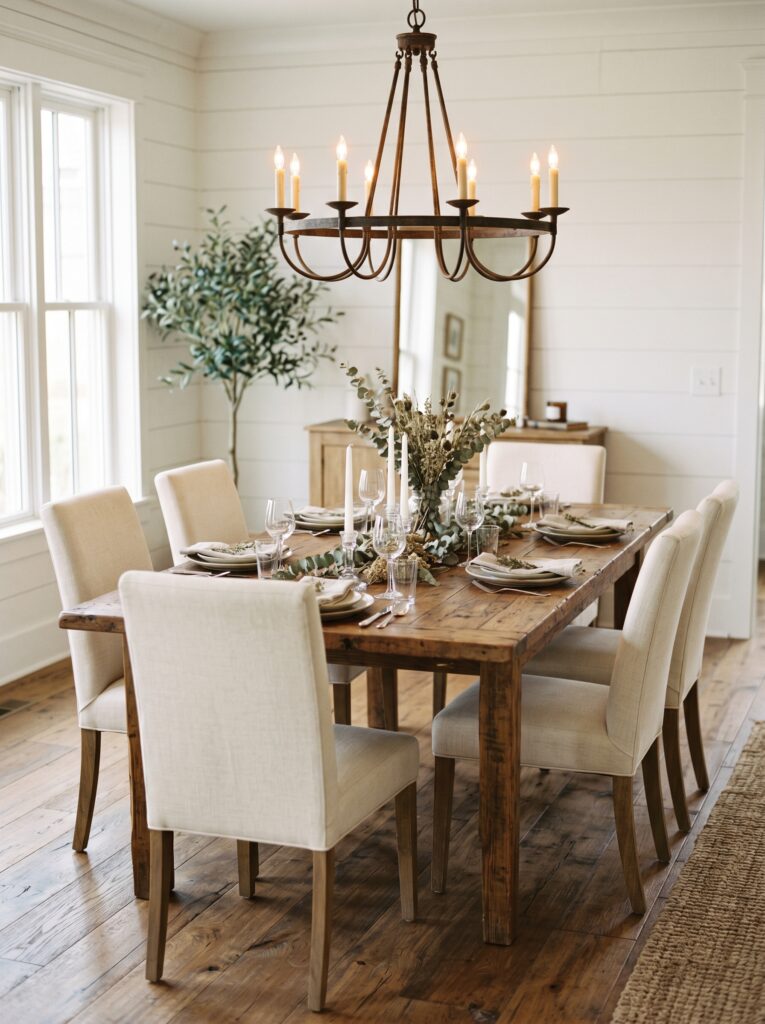
The dining table is the heart of any dining room — and in farmhouse design, a reclaimed or solid wood table with visible grain, natural imperfections, and a sturdy presence is the undisputed centerpiece. No other single piece does more to establish the warm, grounded feeling that defines this style.
Key Elements:
- Reclaimed timber or solid hardwood table in a natural, lightly oiled, or whitewashed finish
- Visible wood grain, knots, and surface character — imperfection is a feature, not a flaw
- Size appropriate to the room: at least 36 inches wide for a proper gathering table
- Simple turned or trestle-style legs for authentic farmhouse silhouette
- Matching or contrasting bench seating on one or both sides
- A long table runner in linen or washed cotton to protect the surface while adding texture
- Warm overhead lighting that highlights the table’s natural character
How to Style It:
- Choose a table finish that complements your floor tone — lighter tables on darker floors and vice versa prevents the room from feeling flat.
- Place a long linen runner down the center rather than a full tablecloth — it shows off the wood while adding softness.
- Create a centerpiece that runs along the table length: a row of pillar candles, a runner of greenery, or a collection of varying-height vessels.
- Mix chair styles slightly — four matching chairs plus two end chairs in a complementary but different design adds collected warmth.
- Add a bench along one side instead of chairs for a more relaxed, informal dining atmosphere.
- Keep the table surface clear of permanent decor — show the wood as much as possible and style for occasion.
- Oil or wax the table surface each season to maintain the wood’s appearance and deepen its natural warmth.
In my experience, a reclaimed wood table is the one dining room purchase that genuinely improves with age. Every scratch and mark adds to the story of the piece rather than diminishing it.
2. Shiplap Accent Wall
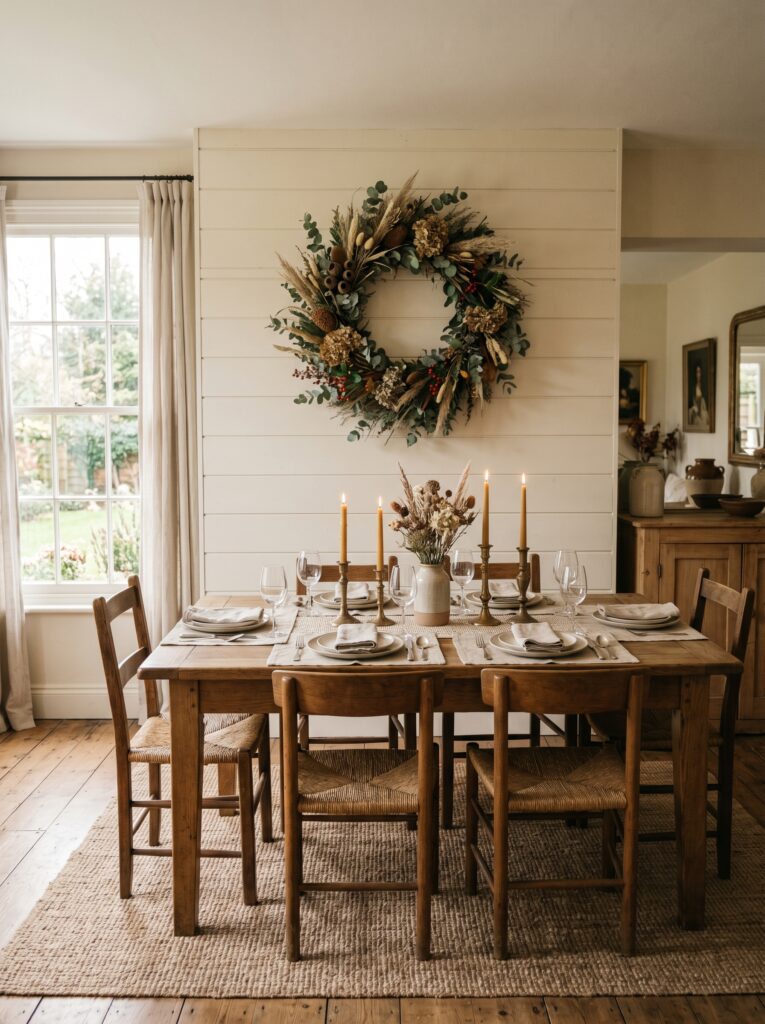
Shiplap — the horizontal wood paneling synonymous with farmhouse interiors — brings instant texture, depth, and architectural interest to a dining room wall. Even in a room with no other farmhouse elements, a single shiplap wall transforms the entire atmosphere. Painted white or in a soft warm tone, it creates a backdrop that makes every other element in the room look more considered and styled.
Key Elements:
- Shiplap boards installed horizontally with thin reveal gaps between each board
- Paint in warm white (not stark white — look for creamy, off-white tones with a warm undertone)
- A large statement piece centered on the wall: an oversized mirror, a wreath, or a gallery arrangement
- Sconce lighting flanking the central wall feature for warmth and balance
- Complementary flooring — wide-plank wood or stone tile enhances the farmhouse aesthetic
- Trim work in the same paint color as the shiplap for a seamless, architectural look
- A sideboard or console table positioned against the shiplap wall for functional styling
How to Style It:
- Decide whether to cover the entire wall or create a partial shiplap feature panel — both work beautifully, but full-wall coverage has more impact in a dining room.
- Prime and paint shiplap boards before installation for a more even finish.
- Choose a warm white or off-white paint — cool or blue-toned whites fight against wood tones and warm lighting.
- Hang one large statement piece centered on the shiplap wall at eye height.
- Flank the central piece with two small sconces or candle wall mounts for balanced lighting.
- Place a sideboard or narrow console against the wall to ground the arrangement and add storage.
- Style the sideboard surface with two to three layered objects: a stack of books, a ceramic bowl, a small potted plant.
3. Vintage Chandelier Focal Point
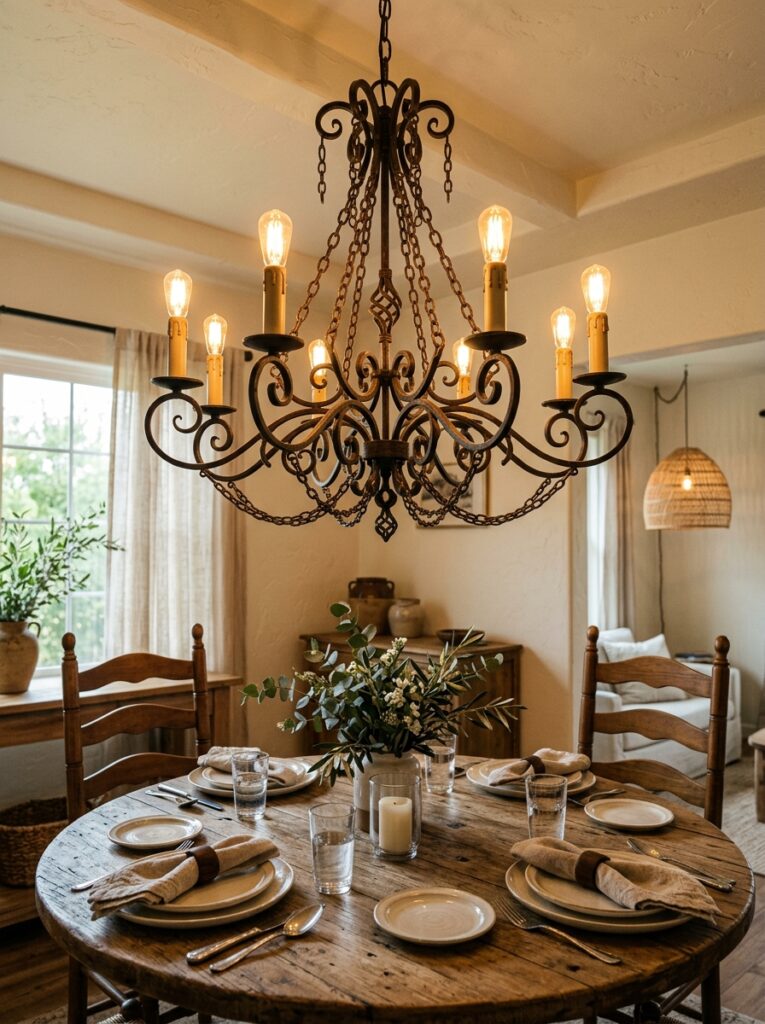
Lighting in a farmhouse dining room is not just functional — it is atmospheric. A vintage or vintage-inspired chandelier hung at the right height over the dining table creates the warm, candlelit quality that makes farmhouse dining rooms feel so inviting. It is the piece that sets the mood before anyone even sits down.
Key Elements:
- Wrought iron, aged brass, or distressed wood chandelier in a candle-arm style
- Edison-style filament bulbs or warm-white LED equivalents (2700K–3000K color temperature)
- Chandelier hung 30–34 inches above the table surface for optimal ambiance
- Size proportional to the table — a chandelier should span approximately half to two-thirds the table width
- A dimmer switch installed on the chandelier circuit — essential for farmhouse atmosphere
- Complementary candles on the table to layer the warm light from multiple points
- A secondary light source in the room (sconces, floor lamp) to avoid harsh contrast
How to Style It:
- Measure the ceiling height before choosing a chandelier — low ceilings need flush or semi-flush designs; standard 8–9 foot ceilings work well with a hanging pendant.
- Position the chandelier centered directly over the table, not centered on the ceiling — these are often different points.
- Hang at approximately 30–34 inches above the table surface for the most flattering, ambient light.
- Replace any bright cool-white bulbs with warm Edison-style filament bulbs immediately.
- Install a dimmer switch — this single change makes more difference to dining room atmosphere than almost any other upgrade.
- Add candles to the table to create a secondary layer of warm, flickering light beneath the chandelier.
- Choose a chandelier that is slightly larger than feels instinctively comfortable — chandeliers in dining rooms almost always look better when they are a size up from expectations.
I’ve noticed that the single most-cited reason a farmhouse dining room falls flat is overhead lighting that is too bright and too cool. A dimmer switch and warm bulbs fix this almost immediately.
4. Mixed Seating Arrangement
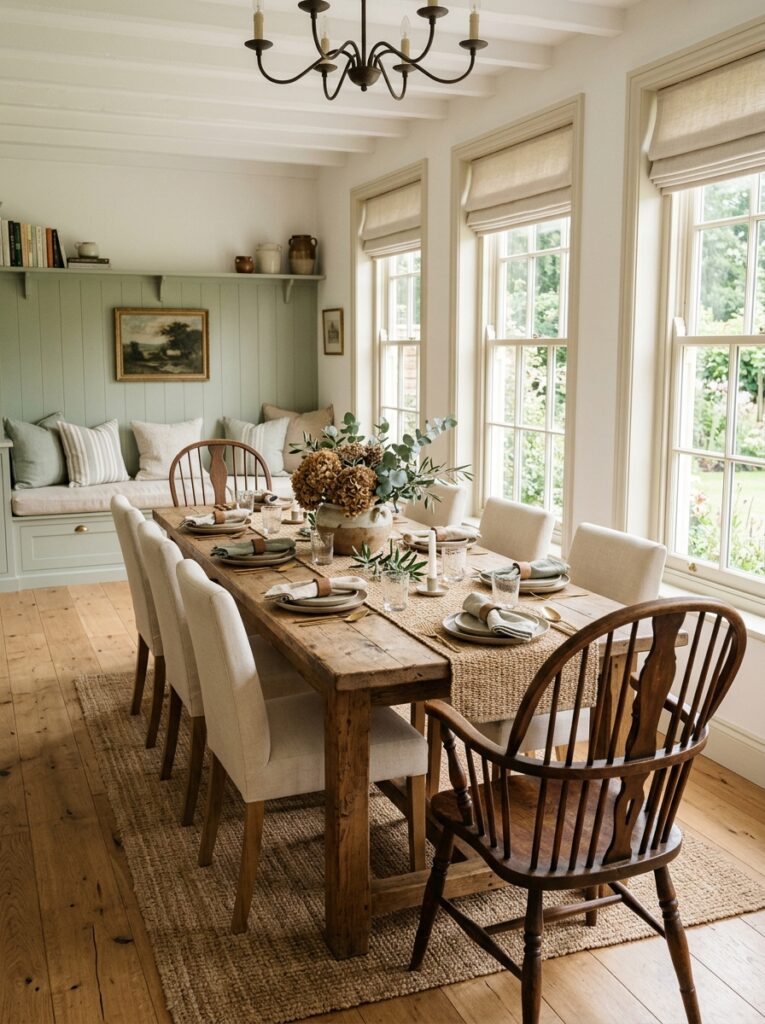
One of the most charming and distinctly farmhouse-feeling details you can add to a dining room is mixed seating — deliberately combining two or three different chair styles around the same table. It gives the room a collected, grown-over-time quality that feels warm and personal rather than showroom-purchased.
Key Elements:
- A primary chair style for the long sides of the table (upholstered in linen or cotton)
- A contrasting accent chair at each table end — a Windsor, an armchair, or a different silhouette
- A built-in or freestanding bench along one side or against a wall
- Consistent palette across all seating — vary the style but keep the tones related
- Linen or cotton seat cushions in neutral tones for softness and comfort
- Consistent leg material (all wood, or all black metal) for visual cohesion
- A table runner or placemats that tie the mixed seating palette together
How to Style It:
- Choose a primary chair style first — this will be your most-used seat and should be comfortable above all else.
- Select an accent end chair that contrasts in silhouette but shares a material or color with the primary chair.
- Add a bench along one long side of the table — even a simple painted bench dramatically changes the informality and seating capacity of the arrangement.
- Keep all cushion fabrics in the same color family even if the styles differ.
- Ensure all chair heights are compatible — seat heights should all fall within one inch of each other for comfortable dining.
- Tie the arrangement together with a long table runner that incorporates a color or tone from each chair style.
- Add a small lumbar cushion to the bench for comfort and a decorative touch.
5. Woven Jute Dining Rug
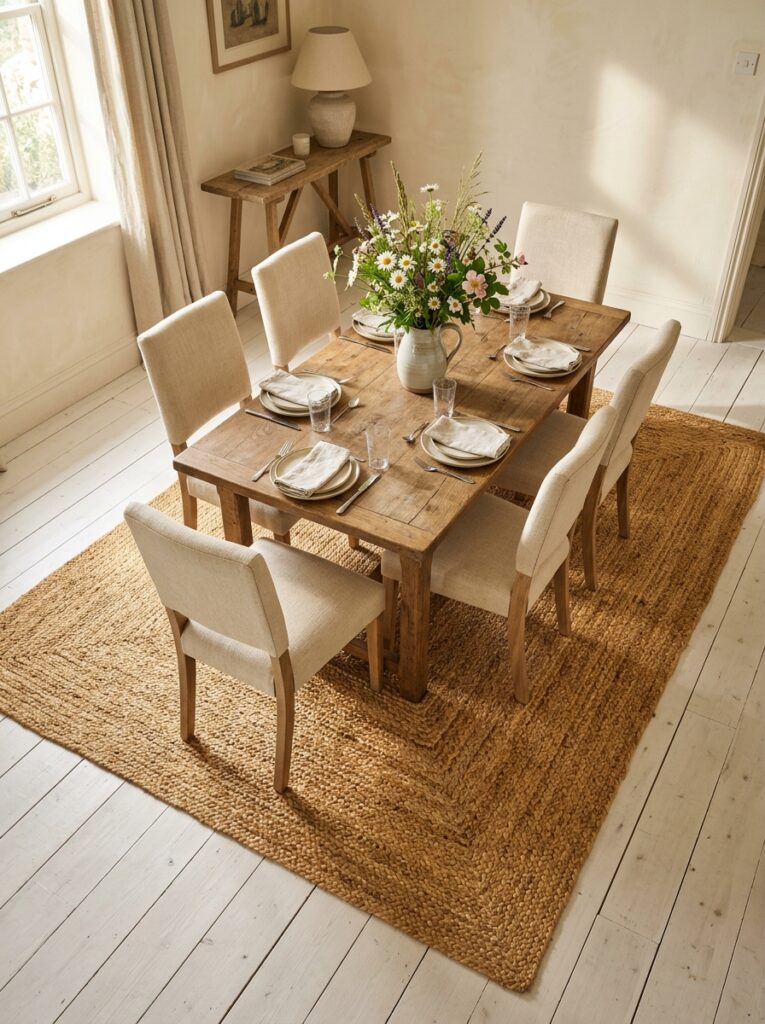
A rug beneath a dining table might seem like a purely decorative choice, but in a farmhouse dining room, it does critical styling work. It grounds the table arrangement, defines the dining zone within a larger open space, softens the acoustic quality of the room, and introduces natural texture that layered rugs and wood simply cannot replicate.
Key Elements:
- Natural jute, sisal, or seagrass rug for authentic farmhouse texture
- Size generous enough that all chair legs remain on the rug even when pulled out — this is the most common sizing mistake
- Minimum rug size for a six-seater table: 8′ x 10′ or 9′ x 12′ (go larger if in doubt)
- Natural, undyed, or lightly bleached colorways — avoid bold patterns in this role
- A rug pad beneath for grip, cushioning, and to protect the floor
- Flat-weave construction for easier dining room cleaning
- A second layered rug in a complementary pattern for added depth (optional but beautiful)
How to Style It:
- Measure carefully before purchasing — the rug should extend at least 24 inches beyond the table edge on all sides.
- Center the rug precisely under the table, not offset to one side.
- Place a non-slip rug pad beneath before positioning furniture.
- Pull out all chairs and check that all four legs remain comfortably on the rug — if any leg falls off the edge, size up.
- Brush or vacuum the jute rug with the grain weekly to maintain the weave’s appearance.
- In dining rooms with young children, choose a flat-weave jute rather than a looped pile — it is significantly easier to clean.
- Layer a smaller vintage or kilim rug on top at one end of the table for a more eclectic, styled look.
6. Open Shelving Display Wall
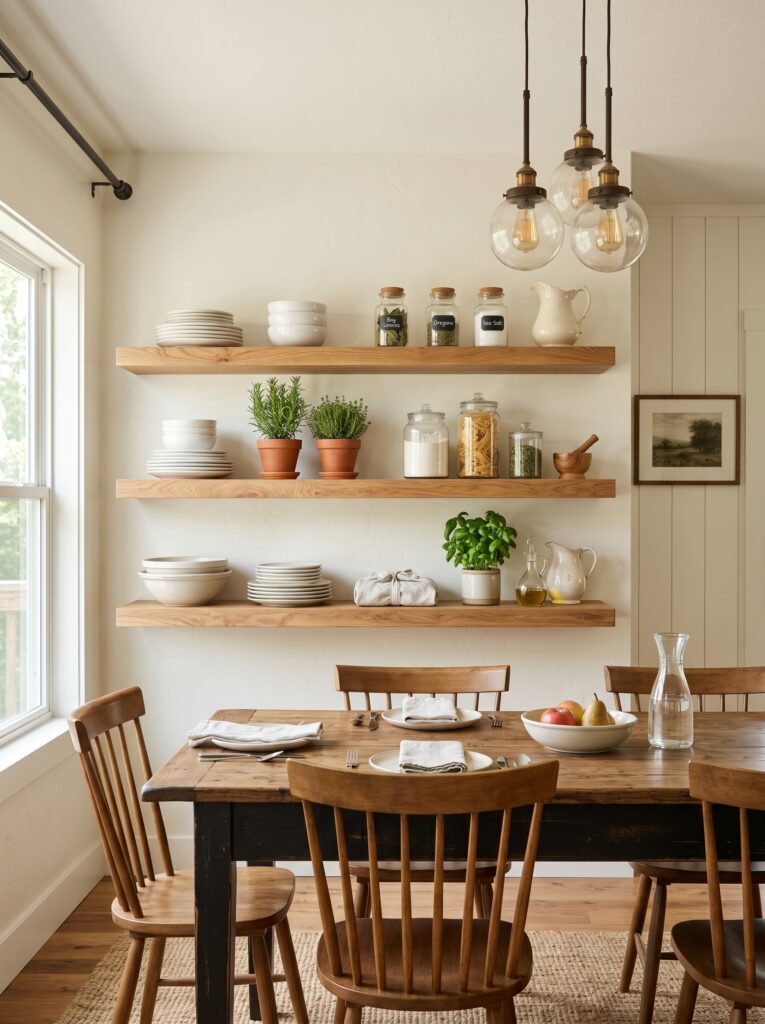
Open shelving in a farmhouse dining room serves as both practical storage and a beautiful, ever-changing display. Unlike closed cabinetry, open shelves invite you to show the things you love — heirloom ceramic dishes, vintage glassware, a collection of pitchers, stacks of linen napkins. The result is a dining room wall that feels curated, personal, and genuinely lived in.
Key Elements:
- Solid timber floating shelves in a natural, whitewashed, or dark-stained finish
- Heavy-duty shelf brackets in aged brass, black iron, or matching timber
- White or cream ceramic dinnerware stacked and displayed openly
- Vintage pitchers, glass apothecary jars, and ceramic vessels for visual variety
- A small potted herb or trailing plant for organic freshness
- Linen napkins folded and stacked as a functional display element
- Consistent spacing between shelves — 12–14 inches allows standard plates and vessels to display comfortably
How to Style It:
- Plan the shelf arrangement before installing anything — sketch the wall with shelf positions and note what you plan to display on each.
- Install shelves with heavy-duty wall anchors appropriate for your wall material — fully-loaded dining shelves are significantly heavier than they appear.
- Start styling from the back of each shelf and work forward — taller pieces at the back, shorter and layered pieces in front.
- Group items in odd numbers and vary heights within each group for visual rhythm.
- Include at least one living element — a small herb plant, a trailing succulent — to add organic softness.
- Leave approximately 20% of each shelf’s surface empty — negative space prevents the arrangement from reading as cluttered.
- Rotate and refresh the display seasonally: swap summer wildflowers for autumn dried botanicals, add holiday elements in December.
7. Barn Door Dining Feature
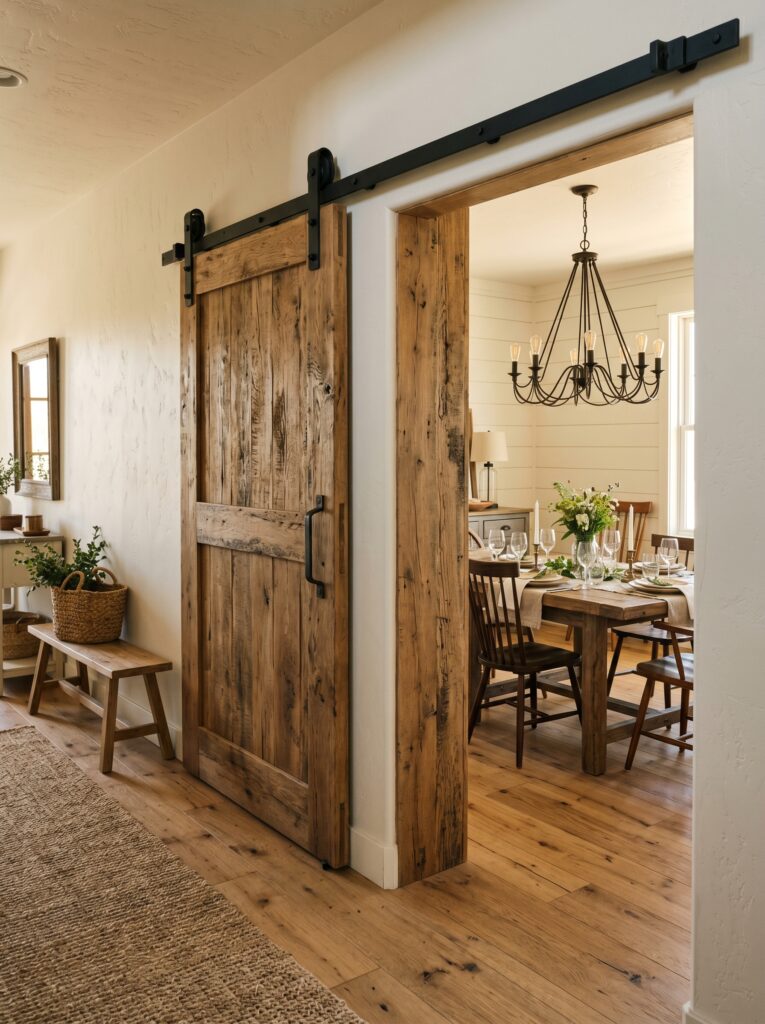
A barn door is one of those architectural details that immediately signals farmhouse style — and it is also one of the most practical solutions for dining rooms in homes where a traditional swinging door consumes valuable space. The combination of natural timber and matte black hardware is a farmhouse classic, and the sliding mechanism adds a satisfying, tactile quality every time it opens.
Key Elements:
- Solid wood or wood-look barn door panel in natural, whitewashed, or dark-stained finish
- Matte black sliding track hardware (heavy-duty rated for the door panel weight)
- Soft-close stoppers at both ends of the track for quiet, elegant operation
- Door panel sized 2–4 inches wider and taller than the door opening on all sides
- Consistent finish between the door and other wood tones in the dining room
- A simple door pull in aged brass or matte black for an authentic detail
- Wall space on the opening side sufficient to accommodate the full door panel when open
How to Style It:
- Measure carefully — the door panel needs room to fully slide open without obstructing a light switch, window, or adjacent door.
- Install the track level — even a slight slope will cause the door to drift open or closed on its own.
- Choose a door panel that complements the dominant wood tone in the dining room rather than competing with it.
- Add a floor guide at the base of the door to prevent the bottom from swinging away from the wall.
- Style the wall beside the barn door with a simple accessory — a wall sconce, a small framed print, or a hook with a linen apron — to complete the vignette.
- Match the barn door hardware finish to at least one other metal detail in the dining room for cohesion.
- If privacy is needed, add a simple hook-and-eye latch at the edge of the door rather than a lock — it maintains the farmhouse aesthetic.
I’ve seen barn doors transform dining rooms in homes of every age and style. The sliding mechanism alone adds a sense of architecture and intention that a standard door simply does not.
8. Neutral Linen Chair Cushions
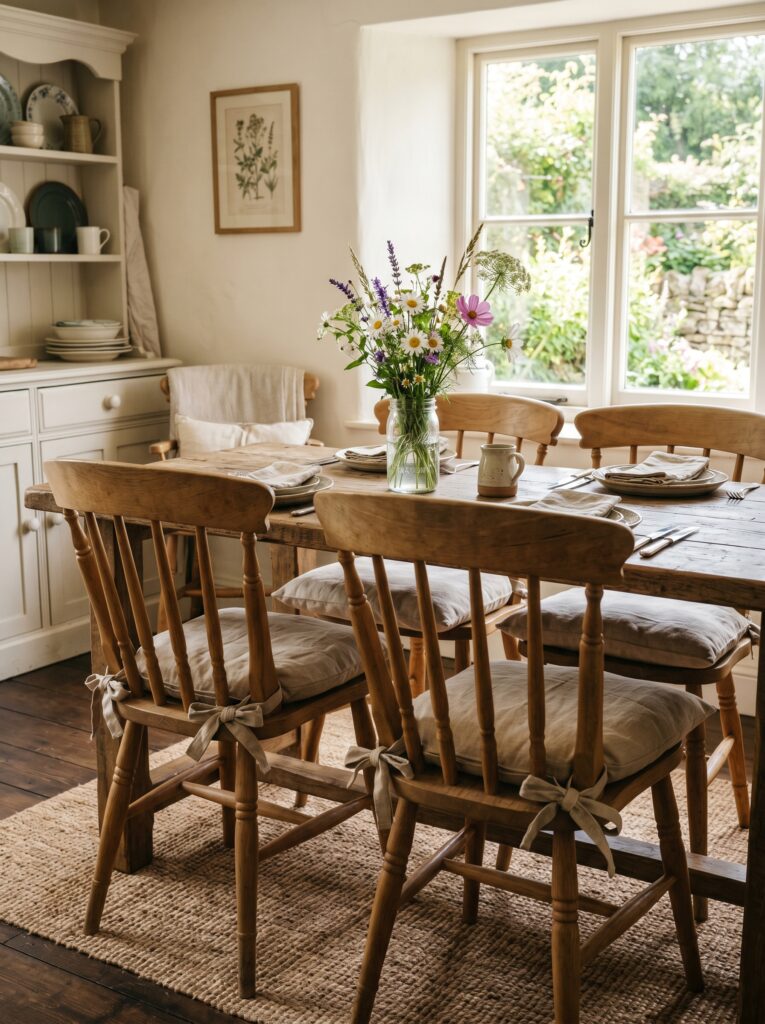
Linen cushion covers on dining chairs might seem like a small detail, but they quietly transform a dining room from stark to soft. They add texture, introduce washable practicality, and give hard dining chairs an instant upgrade in comfort and visual warmth. Natural linen — undyed or in soft neutral tones — is the most versatile and authentically farmhouse choice.
Key Elements:
- Natural linen or linen-cotton blend fabric in undyed, cream, warm gray, or soft sage tones
- Simple tie-on design with fabric bows at the chair back spindles
- Seat pad filled with high-density foam or cotton wadding for real comfort
- Removable, machine-washable covers for practical family use
- Consistent cushion covers across all chairs (variety of chair styles, consistent cushion)
- An optional contrasting tie — a stripe or check in a complementary tone — for subtle detail
- Cushions slightly oversized relative to the seat for a relaxed, casual drape
How to Style It:
- Measure each dining chair seat carefully before purchasing or sewing cushion pads — farmhouse chairs often vary slightly in size.
- Choose a linen weight that drapes softly rather than sitting rigidly — medium-weight linen is ideal.
- Wash the linen cover before first use to pre-shrink and achieve the relaxed, lived-in texture farmhouse style calls for.
- Tie the bow at the back of each chair loosely — overly tight bows look stiff and formal.
- Iron or steam the cushion covers lightly after washing — slightly wrinkled linen looks casual; deeply creased linen looks unkempt.
- Replace cushion covers seasonally to keep the dining room feeling fresh: cream linen for spring, a warmer wheat tone for autumn.
- Keep a second set of covers laundered and ready — dining chair cushions benefit enormously from regular rotation.
9. Galvanized Metal Centerpiece Styling
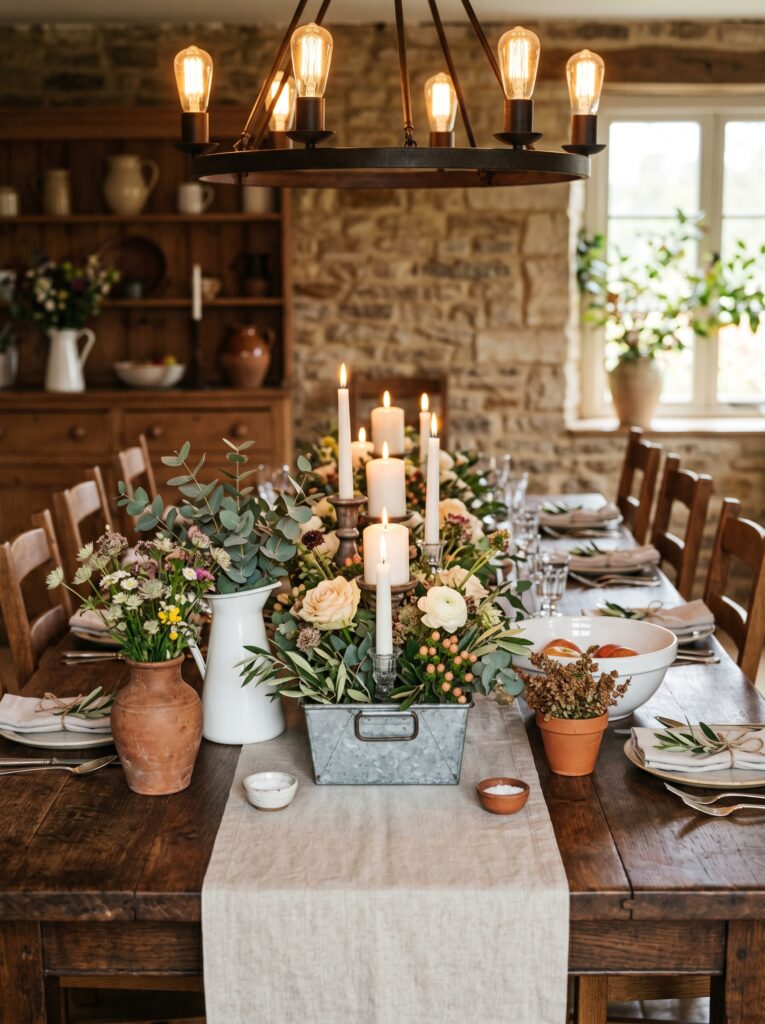
Galvanized metal — the silvery, slightly matte industrial material used in vintage farm buckets and troughs — is one of the most recognizable farmhouse styling elements. As a centerpiece vessel, it brings an authentically rustic quality while remaining incredibly versatile. Fill it with wildflowers and it feels cottage-like. Fill it with white roses and greenery and it reads as elegant farmhouse. Add candles and pine for the holidays and it transforms completely.
Key Elements:
- A galvanized metal trough, bucket, or planter as the primary centerpiece vessel
- Seasonal botanicals: wildflowers, eucalyptus, dried wheat, cotton stems, or herbs
- White pillar candles or tapered candles in aged brass holders flanking the trough
- A linen or washed cotton table runner beneath the centerpiece arrangement
- Secondary vessels in terracotta or aged ceramic at the table ends for depth
- Aged brass or matte black candleholders for warm light and metallic contrast
- Loose, gathered styling rather than formal floristry arrangements
How to Style It:
- Choose a trough or vessel sized to approximately one third the length of your dining table — long enough to be impactful, short enough to allow easy conversation across the table.
- Place the galvanized trough directly on the linen runner, slightly off-center for a more relaxed aesthetic.
- Fill with water and loose-gathered botanicals — mix heights, textures, and scales freely.
- Flank with three to five white pillar candles of varying heights in simple holders.
- Add two or three secondary vessels at the table ends with a single stem or a small cluster.
- Swap the botanicals with the season: spring wildflowers, summer garden roses, autumn branches, winter evergreens.
- Never over-arrange — the most beautiful farmhouse centerpieces look gathered, not designed.
10. Vintage Hutch or Sideboard Display
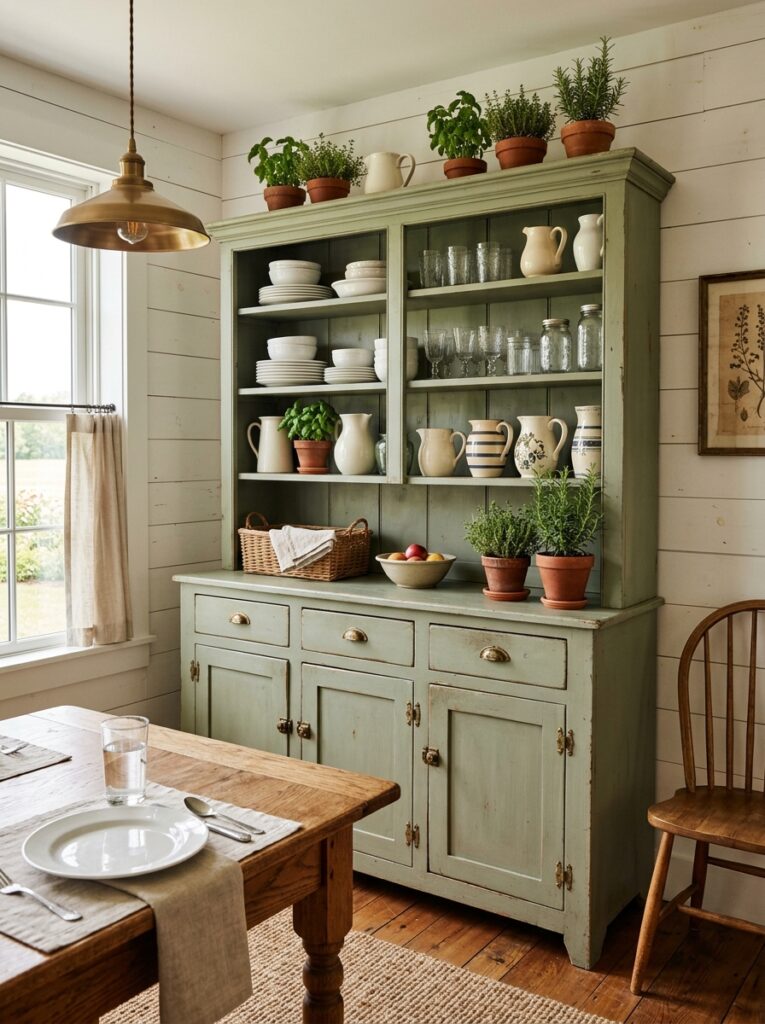
A vintage hutch or sideboard is one of the most functional and beautiful pieces you can add to a farmhouse dining room. It provides storage, a display surface, and an opportunity to showcase the collected, layered aesthetic that defines this style. A gently worn or painted piece with visible age and character always looks more authentic in this context than a brand-new manufactured hutch.
Key Elements:
- A vintage or vintage-inspired hutch, china cabinet, or sideboard in a painted or natural finish
- Soft heritage paint colors: sage green, warm white, dusty blue, or antique cream
- Aged brass, black iron, or ceramic knob hardware
- Upper display area styled with white dinnerware, vintage glassware, and ceramic pitchers
- Lower storage for practical dining essentials: linens, serving pieces, candles
- A small potted herb or trailing plant on one shelf for organic freshness
- A styled surface area on top of the sideboard base for seasonal vignettes
How to Style It:
- Source a hutch with good bones and real wood construction — painting a solid wood piece is a worthwhile investment; painting particleboard is not.
- Sand and prime before painting, and choose a chalky or eggshell finish paint for the most authentic farmhouse result.
- Update hardware immediately — new aged brass or black iron knobs transform a dated piece in minutes.
- Style the open upper display with grouped ceramics, working from tallest to shortest and leaving deliberate negative space.
- Keep the lower closed storage genuinely functional — this is not display space, it is real dining storage.
- Style the hutch top surface with a simple seasonal vignette: a small framed print, a candle, and a botanical element.
- Position the hutch against the wall that is most visible upon entering the dining room — it deserves a prominent position.
A helpful styling trick is to limit the color palette on open hutch shelves to two tones — white ceramics and natural terracotta, for example. More than two colors quickly reads as cluttered rather than curated.
11. Dried Botanical Wall Wreath
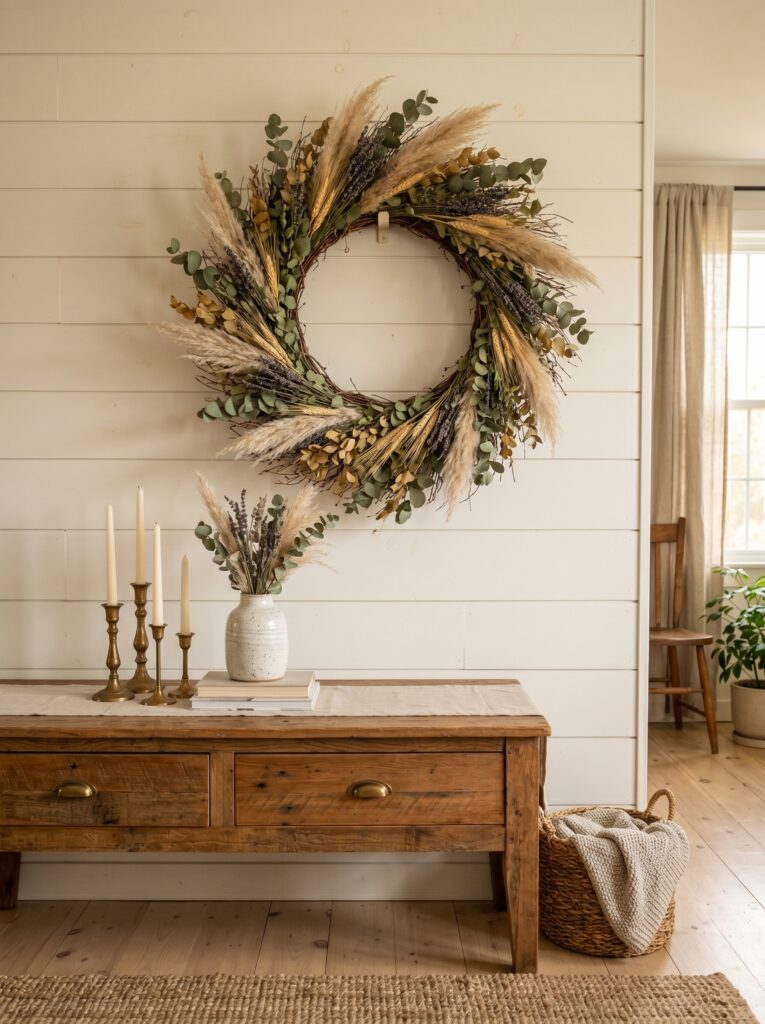
A large dried botanical wreath on the dining room wall does something fresh flowers cannot quite achieve — it stays beautiful for months and gets better looking as it ages and dries further. In a farmhouse dining room, a wreath of pampas grass, dried lavender, preserved eucalyptus, and wheat stems brings texture, organic warmth, and an effortlessly styled quality that reads as both rustic and sophisticated.
Key Elements:
- A large round wreath base (grapevine, wire, or woven grass) 20–30 inches in diameter
- Dried botanicals: pampas grass, lavender, eucalyptus, wheat stems, cotton, or dried roses
- A simple velvet or wired ribbon in a muted, earthy tone for hanging
- A clear picture hook or wreath hanger rated for the piece’s weight
- Placement centered on the wall above a sideboard or at a natural focal point
- Secondary botanical elements echoed in the table centerpiece or sideboard vignette
- Warm lighting nearby — dried botanicals photograph and look stunning in warm, side-lit conditions
How to Style It:
- Choose or make a wreath with enough botanical variety to create depth — at least three to five different dried elements.
- Hang at eye height or slightly higher — approximately 6–8 inches above any furniture below.
- Center the wreath on the wall as the deliberate focal point — it should feel placed with purpose.
- Echo one botanical element from the wreath in the table or sideboard styling below: a sprig of lavender, a wheat stem in a vase.
- Avoid placing dried wreaths in direct, harsh sunlight — the botanicals will fade and bleach unevenly.
- Refresh the wreath each season by adding or replacing individual botanical elements rather than replacing the whole piece.
- A velvet ribbon in deep burgundy, sage green, or natural cream tied at the top adds a polished finishing detail.
12. Window Seat Dining Nook
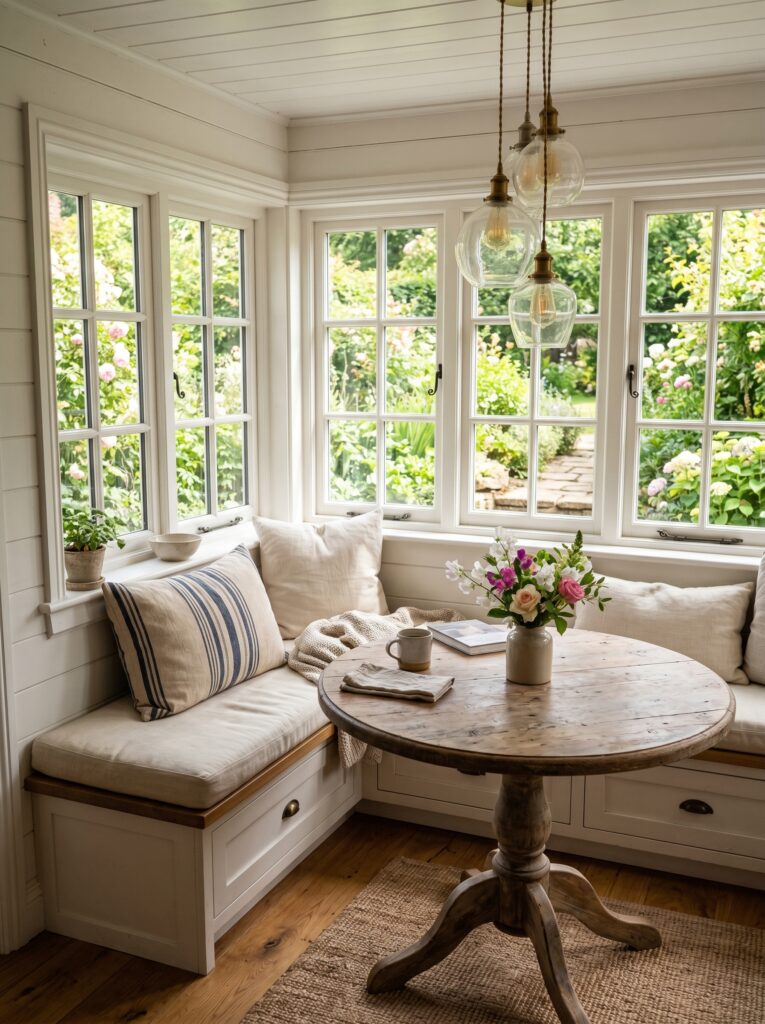
A window seat dining nook is one of the most beloved and sought-after features in any home. When built into a farmhouse dining room, it creates a space within the space — a cozy, intimate eating area that feels completely different from a standard dining arrangement. It maximizes natural light, adds built-in seating storage, and creates the kind of everyday dining spot where people genuinely want to sit with their morning coffee.
Key Elements:
- A built-in bench seat positioned beneath a window or in a bay window alcove
- High-density foam seat cushion upholstered in washable linen or durable cotton
- Decorative lumbar cushions in complementary farmhouse fabrics
- A round or square pedestal table to complement the nook’s proportions
- Pendant lighting positioned to light the table from above rather than ceiling-center
- Painted shiplap or beadboard paneling on the nook walls and seat surround
- Storage drawers or lift-top access built into the bench base for practical dining linen storage
How to Style It:
- Position the dining table so all seated occupants have a natural view out of the window — the whole point of a window seat nook is the light and view.
- Upholster the bench seat in a fabric rated for everyday use — linen blends with a tight weave handle daily life significantly better than pure linen.
- Add two to three lumbar cushions for back support — window seat dining nooks without back cushions are uncomfortable for extended sitting.
- Choose a round table for the most sociable, space-efficient nook arrangement.
- Hang one pendant light or a small chandelier directly over the table rather than relying on a ceiling-center fixture.
- Paint the nook interior in a slightly warmer or deeper tone than the main dining room walls for a cocoon-like effect.
- Keep the window treatment minimal — simple linen curtains or bare windows let in maximum natural light.
13. Layered Table Setting for Everyday Beauty
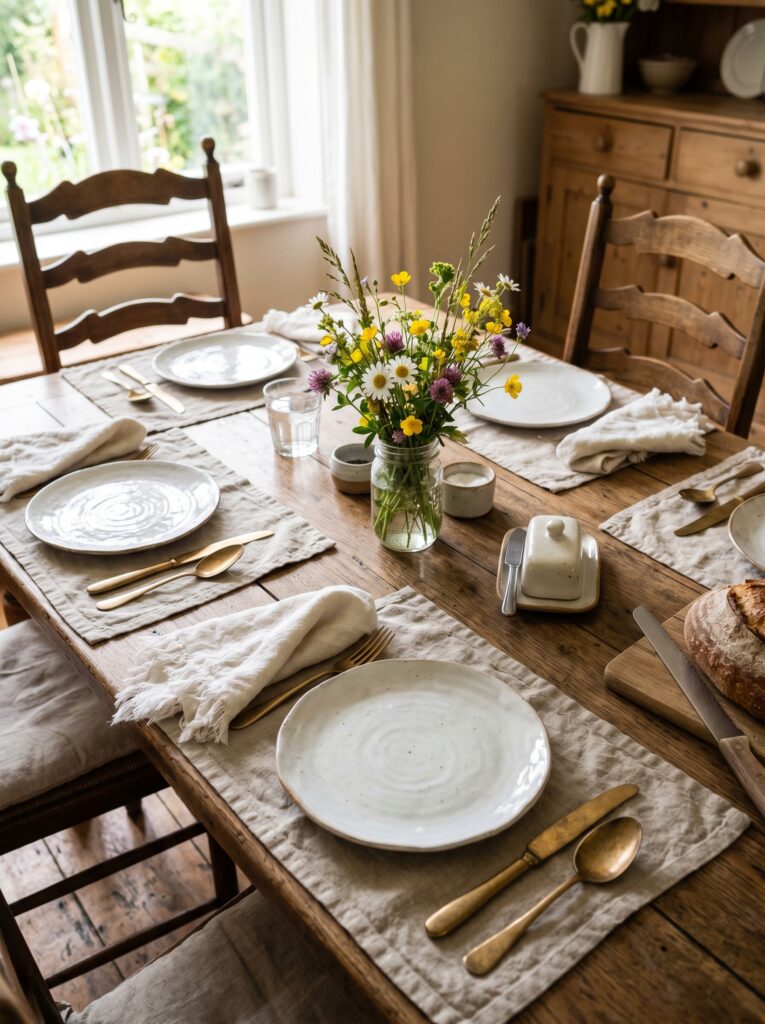
One of the most underrated farmhouse dining room habits is setting the table beautifully even for everyday meals. Not formally, not elaborately — but intentionally. A linen placemat, a cloth napkin, simple ceramic dishes, and a small vase of whatever is growing in the garden at the moment. This daily practice is what makes farmhouse dining rooms feel genuinely lived in and loved.
Key Elements:
- Natural linen or washed cotton placemats in neutral or earth tones
- White or cream ceramic dinnerware — simple, sturdy, imperfect is best
- Linen cloth napkins folded loosely or tucked casually under the plate edge
- Simple flatware in aged brass, matte black, or brushed silver
- Mason jars, vintage bottles, or ceramic pitchers as casual flower vessels
- A single candle or small lantern for everyday warmth at dinner
- Seasonal botanical elements: a sprig of herbs, a small branch, a single bloom
How to Style It:
- Invest in a set of linen napkins — they launder beautifully, soften with each wash, and elevate every meal without effort.
- Lay placemats parallel to the table edge, approximately one inch from the table front.
- Stack a dinner plate, a side plate, and a bowl for a layered, visual-depth place setting.
- Fold the napkin loosely and tuck it under the left edge of the plate rather than forming a formal fold.
- Place cutlery directly on the placemat rather than on the table for a cleaner look.
- Add a single small vessel of something living or growing at the table center — this is the detail that makes the whole arrangement feel cared for.
- Light one candle at the center of the table even for weeknight dinners — the difference in atmosphere is immediate and significant.
I’ve noticed that the families with the most beautiful farmhouse dining rooms are often the ones who set the table every single day, even for simple weeknight meals. The habit builds the aesthetic.
Common Farmhouse Dining Room Mistakes to Avoid
Even with beautiful individual elements, these common mistakes can hold a farmhouse dining room back from its full potential:
- Going too matchy-matchy. A set of perfectly identical chairs, a perfectly matched dinnerware set, and a perfectly coordinated rug and curtain combination looks manufactured rather than gathered. Introduce at least one deliberate contrast.
- Using cool gray as a base color. Cool grays fight against the warm wood tones and warm lighting that farmhouse dining rooms depend on. Choose whites and neutrals with warm or yellow undertones instead.
- Undersizing the rug. This is the most common dining room mistake of all. A rug that is too small looks like a bath mat under the table. Always size up.
- Overlighting the room. A single bright overhead light is the enemy of farmhouse atmosphere. Layer your lighting: chandelier on a dimmer, wall sconces, candles on the table.
- Accessories that are too new and too matching. Farmhouse style needs pieces that look like they arrived at different times from different places. Seek out vintage, handmade, and imperfect pieces deliberately.
- Neglecting the table surface. A beautiful reclaimed wood table hidden under a full tablecloth every day loses its purpose. Use a runner instead and let the wood be seen and appreciated.
Farmhouse Dining Room Style Guide
| Element | Budget Option | Mid-Range Option | Investment Option |
|---|---|---|---|
| Dining Table | Painted pine trestle table | Solid oak or pine farmhouse table | Reclaimed timber custom table |
| Seating | Painted wooden chairs | Linen-upholstered dining chairs | Mixed vintage + custom upholstery |
| Lighting | Iron pendant from big-box store | Vintage-inspired chandelier | Antique or artisan chandelier |
| Rug | Natural sisal or jute (8×10) | Woven cotton flatweave rug | Vintage kilim or hand-knotted rug |
| Wall Decor | DIY shiplap panel | Professionally installed shiplap | Built-in wainscoting or board and batten |
| Centerpiece | Mason jar with garden flowers | Galvanized trough with market blooms | Curated dried botanical arrangement |
| Storage | Painted IKEA shelving unit | Vintage sideboard from thrift store | Antique hutch or custom built-ins |
Frequently Asked Questions
What colors work best in a farmhouse dining room? Warm whites, creamy off-whites, warm greiges (gray-beige), and soft sage greens are the most successful farmhouse dining room base colors. The key is to choose tones with a warm undertone rather than a cool one — warm whites with yellow or red undertones sit beautifully alongside natural wood tones and warm lighting, while cool blue-toned whites create an unintentional conflict.
How do I achieve a farmhouse dining room look on a tight budget? Start with what matters most: the dining table. A solid wood table — even a budget one from a thrift store that is sanded and oiled — immediately establishes the aesthetic. Then add linen placemats, cloth napkins, and a simple botanical centerpiece. These three additions cost very little and make an enormous difference. A dimmer switch on the existing light fixture and a set of warm-toned bulbs will transform the atmosphere for under twenty dollars.
What type of lighting works best in a farmhouse dining room? A wrought iron, aged brass, or distressed wood chandelier or pendant directly over the dining table is the foundation. Equally important is the bulb choice — always use warm-white filament or LED bulbs rated at 2700K–3000K. Install the fixture on a dimmer switch. Add candles on the table as a secondary light layer. This three-part lighting approach — overhead, dimmed, plus candles — creates the signature farmhouse dining atmosphere.
Do farmhouse dining rooms work in modern homes and new builds? Absolutely. The farmhouse aesthetic is one of the most adaptable design styles for new construction. A reclaimed wood table, shiplap paneling on one wall, warm lighting, and natural textile accessories can introduce significant farmhouse warmth into even the most contemporary new-build dining room. The style does not require old architecture — it just requires the right materials, textures, and layering approach.
What is the best rug size for a farmhouse dining room? For a standard six-seat rectangular dining table, an 8′ x 10′ rug is the minimum size. A 9′ x 12′ is often better. The rule to remember: all chair legs should remain on the rug even when chairs are pulled out for seating. Measure your table, add 48 inches to each dimension (24 inches per side), and that gives you the minimum rug size needed.
How do I make a small dining room feel like a farmhouse space? Focus on vertical interest — open shelving, a wall-mounted hutch, or a shiplap accent wall draw the eye upward and make small rooms feel larger. Use a round table, which takes up less floor space and allows easier movement around it. Choose light, warm neutral wall colors. Keep the floor as visible as possible. And always invest in good lighting — a beautiful chandelier scaled appropriately to a small room is far more impactful than a larger chandelier crowding a small space.
Final Thoughts
The beauty of farmhouse dining rooms is that they are built for real life — for Sunday dinners, birthday celebrations, quiet weeknight meals, and holiday gatherings that spill out of the kitchen and fill the table with people and conversation. Every element, from the reclaimed wood table to the loosely folded linen napkin, is chosen to make the space feel welcoming rather than precious.
You do not need to change everything at once. Start with one idea — a new light fixture, a vintage hutch, a set of linen napkins — and build from there. I’ve seen how even the smallest intentional changes can completely transform the feeling of a dining room. Save this guide to your Pinterest boards, share it with someone planning a dining room refresh, and come back to it whenever you are ready for the next layer of warmth and style.

Indy Santos is a passionate interior styling specialist and home living enthusiast with a focus on contemporary decor, smart space planning, and affordable design inspiration. At Inspired Homex, she provides readers with fresh decorating concepts, actionable advice, and professional guidance to create comfortable, elegant, and well-organized homes that reflect their personal style.